
What Rheonics products are involved? What is this article helpful for? |
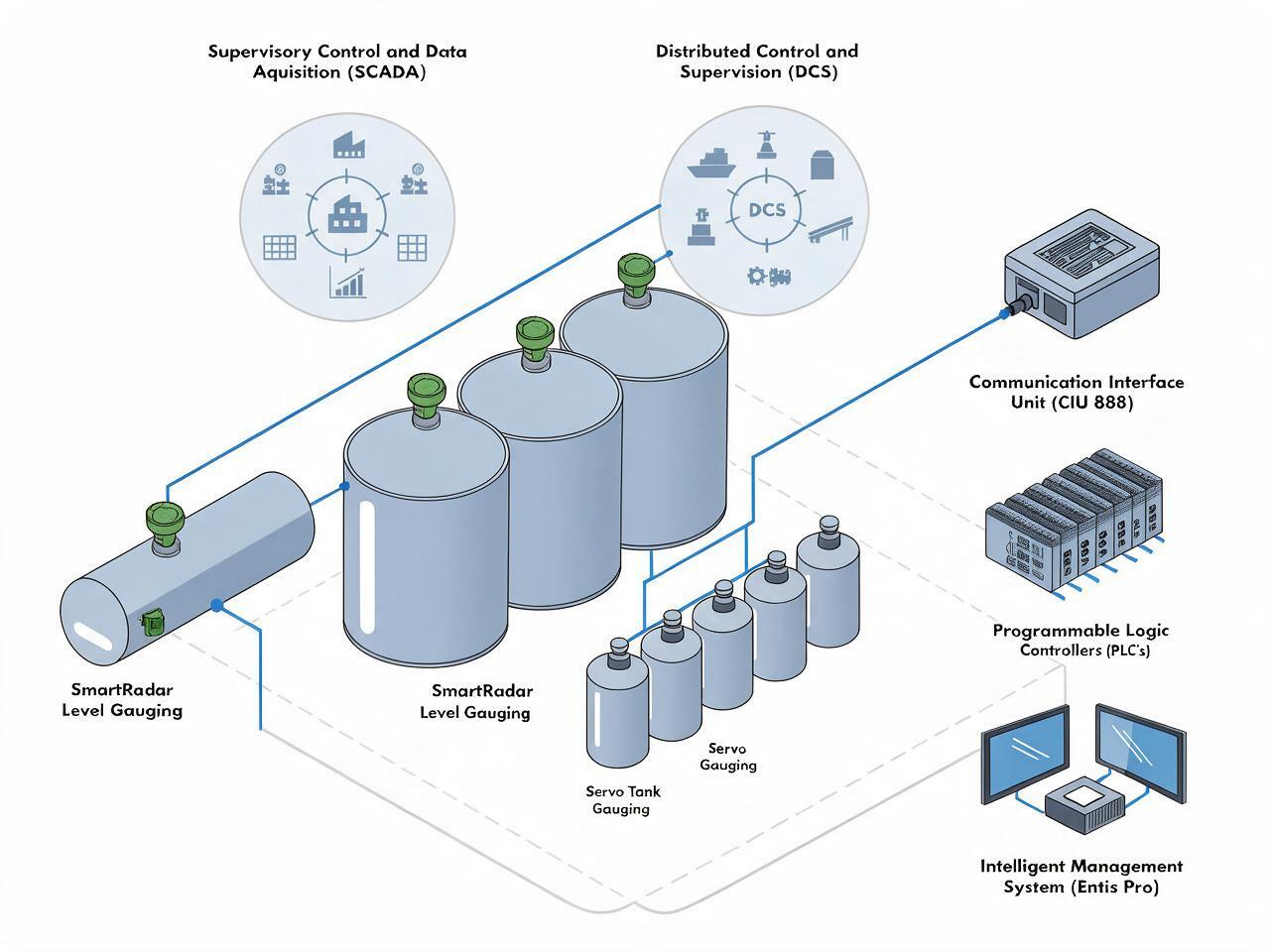
Honeywell's Enraf tank gauging system is a tank farm inventory measurement platform composed of three layers:
- Field-level gauges (servo and radar level gauges, temperature spot elements)
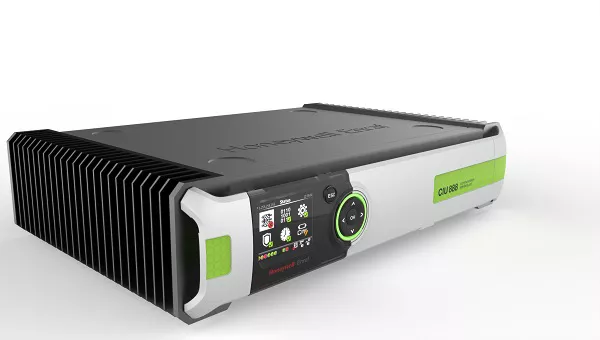
- The CIU 888 communication interface that scans field data and runs inventory calculations
- Host-level software (such as Entis or a DCS) that consumes that data
Density is one of the required inputs for those calculations and is conventionally sourced from servo density dips or manual sampling. This article covers how Rheonics real-time density sensors integrate into this system as a continuous density source, and which Rheonics sensor applies depending on the application: the SRD for liquid density, or the DVP for gas density. The SME-TRD (Modbus RTU tank-farm variant) is the field device that carries either sensor's reading onto the CIU 888.
The Enraf ecosystem is deliberately open on both sides of the CIU 888, which defines the integration paths available for Rheonics sensors. This article walks through each path, the inventory calculation chain the CIU 888 performs, and the serial and unit-conversion settings needed for a clean commissioning.
1. Field Side: Native Integration via Modbus Master
The CIU 888 Serial Modbus Input card supports Modbus Master operation over RS-485/RS-232, with up to 32 Modbus field devices multi-dropped per port.
| A Rheonics sensor with Modbus RTU sits directly on a CIU 888 field port as a native tank-farm device. No protocol gateway is needed. |
2. Host Side: Automatic Pass-Through to Entis and DCS
Toward the host, the CIU 888 exposes Modbus TCP/IP, OPC UA TCP, and serial Modbus. Once Rheonics data is scanned in on the field side, it flows through to Entis, Experion, or other connected hosts automatically, with no additional mapping step required on the host interface.
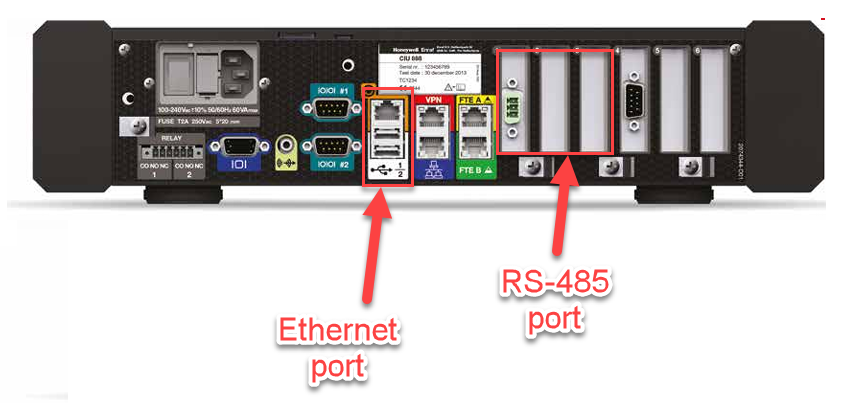
| A Rheonics sensor with Modbus RTU sits directly on a CIU 888 field port as a native tank-farm device. No protocol gateway is needed. |
3. Calculation Chain: Where SRD Density Fits In
The CIU 888 performs inventory calculations per API MPMS Chapter 12.1, using ASTM D1250 / API 11.1 VCF (volume correction factor) tables. This calculation chain today typically relies on servo density dips or manual samples for observed density. A real-time density feed from a Rheonics sensor supplies this same input, replacing intermittent dips or manual sampling with a continuous, live value.
Which Rheonics sensor to use: the correct choice depends on what's being measured, not a single default. For liquid product tanks (crude, refined fuels, lube oils), the SRD provides the inline liquid density feed. For gas or vapor-phase applications, the DVP is the appropriate choice instead — it is designed for gas density measurement, which the SRD is not. Both connect to the CIU 888 the same way, via an SME-TRD on the Modbus field port; only the sensor itself changes with the application.
What does ASTM D1250 do?
It is the standard set of petroleum measurement tables (jointly published with API as MPMS Chapter 11.1) used to correct an observed density or API gravity reading, taken at whatever temperature the product happens to be, to its equivalent value at a standard reference temperature — 60°F in the US, 15°C internationally. The same tables supply the volume correction factor (VCF) needed to adjust a measured tank volume for thermal expansion or contraction, so that a terminal can report inventory on a consistent, temperature-normalized basis rather than a raw, as-measured one. Tables are organized by product group (crude oil, generalized/refined products, lubricating oils, and so on), since different products expand and contract at different rates.
This matters for the integration because the CIU 888's inventory chain runs this correction continuously — every accepted density reading gets passed through the VCF calculation. Feeding it a real-time value from the SRD or DVP instead of a periodic servo dip or manual sample means the VCF correction, and therefore the reported standard volume, updates continuously rather than only at sampling intervals. The accuracy of the underlying ASTM D1250 correction is unchanged; what improves is how current the density input to that correction is.
4. Serial Compatibility Check
SME-TRD ships with the following defaults:
| Parameter | SME-TRD Default |
|---|---|
| Slave ID | 1 |
| Baud rate | 38400 |
| Parity | Odd |
These defaults fall inside the CIU 888 Modbus Master card's supported range of 1200–38400 baud, so no field-side baud rate change is required for a standard commissioning.
5. Density Unit Conversion
The Rheonics sensor (SRD or DVP) reports density in g/cc, while the CIU 888 and downstream inventory calculations typically expect kg/m³, °API, or RD 60/60. This conversion must be handled at exactly one point in the chain — either at the sensor or at the CIU 888 — and not duplicated at both ends. Deciding where this conversion happens, and confirming it during commissioning, prevents the most common support ticket associated with this integration: a density value that reads correctly at the sensor but appears out of range at the host.
Related articles: See the SME-TRD, SRD, and DVP product pages for full specifications.
References [1] Honeywell — Communication Interface Unit (CIU 888) [2] API Manual of Petroleum Measurement Standards (MPMS), Chapter 12.1 — Calculation of Petroleum Quantities [3] ASTM D1250 / API 11.1 — Petroleum Measurement Tables (VCF) [4] Honeywell — Enraf Tank Gauging overview |